Melbourne will become a global meeting point for gender equality next week, as Women Deliver 2026 brings more than 6,500 advocates, policymakers, First Nations leaders and movement organisers to Australia.
The conference will run from April 27-30 in Melbourne, known as Naarm to the aboriginal peoples who lived there. Organisers describe it as the first Women Deliver Conference regionally hosted by the Oceanic Pacific. (Women Deliver)
Women Deliver 2026
Women Deliver says the 2026 conference will take place on the lands of the Wurundjeri Woi Wurrung people of the Kulin Nation.
Naarm (or Narrm) is the traditional Indigenous name for the area encompassing Melbourne, Victoria, and its surrounding bays and waterways. It is a Woiwurrung and Boonwurrung word used by the Kulin Nation to describe the region, particularly the area around the Yarra River and Port Phillip Bay, acknowledging their enduring 65,000-year connection. The event’s theme, “Change calls us here,” frames the gathering as a response to global pressure on women’s rights, health, First Nations leadership and locally driven advocacy.
Shobha Shukla of CNS reports that the conference will focus on regional leadership and intersectional approaches to political, social and economic change. Her original story also highlighted the importance Women Deliver places on Pacific women, Indigenous women and First Nations leadership.
Regional Hosting Model
For Women Deliver, the regional hosting model marks more than a change of venue.
The organisation says the model aims to centre local leadership, regional impact and “power-sharing” beyond the conference itself.
Louisa Wall, Oceanic Pacific Mobilisation Advisor for Women Deliver Conference 2026, said regional leadership should shape the agenda.
Wall is a First Nations tribal representative, former Member of Parliament in Aotearoa New Zealand, human rights advocate and former athlete. Shukla reported that Wall sees the conference as a chance to move power closer to communities affected by the issues under discussion.
“Our region is on the forefront of climate change — cyclones, rising seas, and the erosion of lands and livelihoods,” Wall said. “Pacific women also face high rates of gender-based violence and historically low political representation. Women Deliver Conference 2026 will elevate these regional feminist priorities of climate and gender justice.”
Wall said women’s leadership and First Nations leadership should not sit outside the main conversation.
“Women’s leadership must not be an afterthought,” she said. “It must be central to solutions at every level.”
Australia enters the conference with its highest recorded ranking in the World Economic Forum’s Global Gender Gap Report. The 2025 report ranked Australia 13th out of 148 countries, up 11 places from the previous year. (Ministers’ Media Centre)
Victoria also gives the conference a local policy backdrop.
The state’s gender equality strategy, released in 2023, sets out a four-year plan covering workforce, education, safety and gender-responsive budgeting. (Victoria Government)
Treaty Legislation
Victoria also became the first Australian state to enact statewide treaty legislation with First Peoples. The Statewide Treaty Act 2025 establishes Gellung Warl, a representative body intended to continue the treaty process. (Treaty Victoria)
That Australian setting gives Women Deliver 2026 a local dimension, even as the event draws global delegates.
Former Australian Prime Minister Julia Gillard, a Women Deliver Ambassador, said the conference comes during a period of war, conflict, economic inequality and political pressure on women’s rights.
“The current economic model is resulting in very unequal outcomes — there is growing poverty, while some continue to amass unimaginable amounts of wealth,” Gillard said.
More than 6,500 advocates will gather in Australia as the Oceanic Pacific hosts Women Deliver for the first time.
She said gender equality advocates need fresh strategies and stronger public support.
“To realise that broad vision, our response must be collective, coordinated, and grounded in protecting rights,” Gillard said. “We need to come together, to think through the challenges that we face, and come up with new strategies to campaign afresh.”
Gillard said those strategies need “a new narrative” that can build global and local support for gender equality.
Peace and Prosperity Not Delivered
Dr Maliha Khan, CEO of Women Deliver, said the global system created after the two World Wars did not deliver the peace and prosperity many countries expected.
Khan said the conference should help reimagine accountability and move resources closer to communities.
“We want to redefine accountability,” Khan said. “We want to have a better resourced and more locally driven, nationally centred movement, and an ecosystem that really centres around those who are most marginalised.”
She said Women Deliver wants to push beyond development language.
“It is about restructuring our resources and responsibilities so that we can deliver — not just development — but justice,” Khan said.
Women Deliver began in 2007 with a strong focus on maternal mortality. Shukla reported that the conference now covers a broader agenda, including women’s health, bodily autonomy, political representation, First Nations leadership and community-driven advocacy.
The Melbourne conference gives the Oceanic Pacific a larger role in that agenda.
For Wall, that shift matters because global conversations often remain too abstract.
She said Women Deliver 2026 offers “a historic opportunity to move power where it belongs — into the hands of communities, women, and indigenous peoples.”
That message will follow delegates into Melbourne when Women Deliver 2026 opens on April 27, placing Australia at the centre of one of the year’s largest global gender equality gatherings.
This NewsBlaze Australia story is based on original reporting supplied by Shobha Shukla, CNS (Citizen News Service).
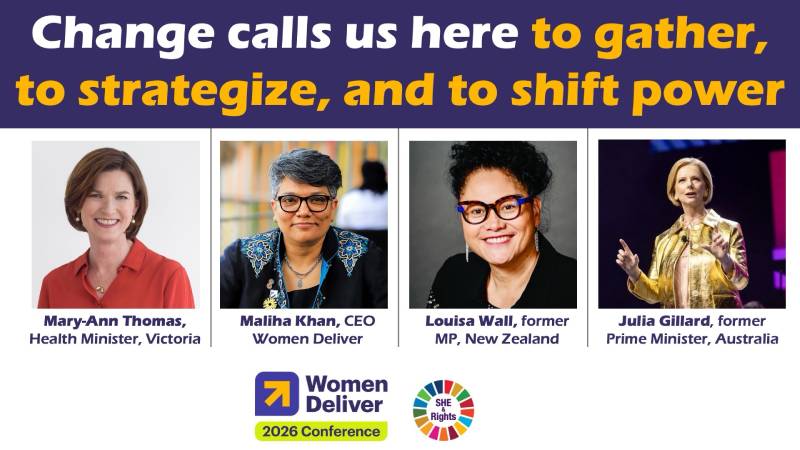
Women Deliver 2026 will bring more than 6,500 advocates to Naarm/Melbourne from April 27-30.