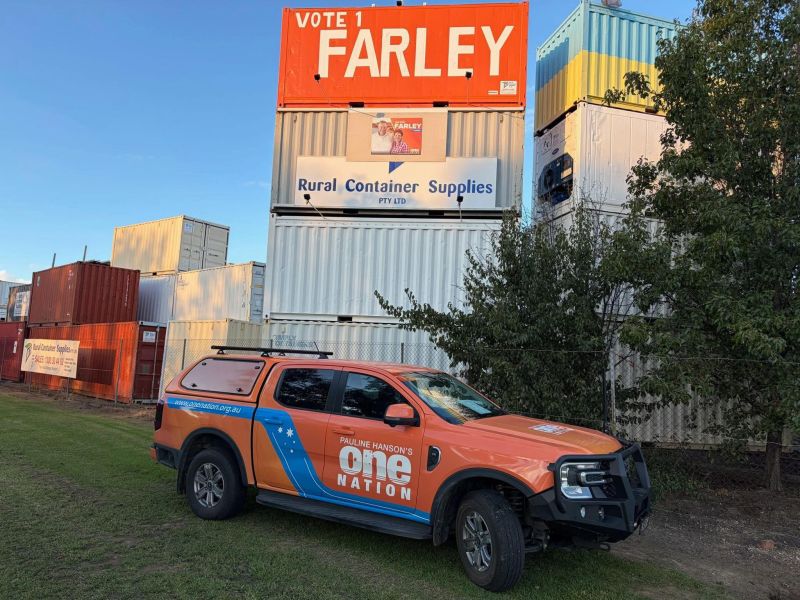
Albury council’s move against a Farrer by-election display about One Nation candidate David Farley may have delivered more publicity than less, after container company owner David Nichols said he planned to remove the explicit “Vote 1” wording rather than fight the matter. The Farrer sign dispute reasoning was not well explained by council.
Mr. Nichols told NewsBlaze Australia the orange container had been in place for about three weeks before council pressure arrived. He said he did not want a prolonged dispute and planned to paint over the election wording, leaving what he described as an ordinary orange Farley container like others used in his business, with only a smaller campaign banner below.
Nichols said the display was his idea, not something Farley organised. He described it as one of his own public statement pieces and said he often builds visual displays, pointing to other creations including a lighted soldier memorial work he made to commemorate the ANZACs.
That narrows the dispute to a sharper question. Was council objecting to a political message on private land, a piece of outdoor advertising, or the combination of both?
Rather than burying the message, the dispute appeared to amplify it online, where a Facebook post with this photo drew thousands of reactions and many supporters said the council had handed the display extra publicity.
“Sometimes attempts to stop something only create more attention to it,” a supporter wrote.
That online reaction sharpened the political effect of a dispute that may otherwise have stayed local and brief. It also raised a clearer question about what rule, exactly, council believed the display had breached.
What Albury’s Public Rules Say
AlburyCity’s election guidance says candidates are responsible for complying with electoral signage rules. It also says council will remove offending signage from council-owned assets, public land, trees, or any public place under AlburyCity’s care or control. The same page says election signs on private land or buildings require the owner’s written consent, and sets size and timing limits for election signage.
That matters because Nichols’ account points to a display on private land, not a sign fixed to council land or a public asset. If that is the case, the issue becomes less about a blanket ban and more about exactly which planning or electoral rule applied.
NSW Planning Portal guidance says some advertising and signage can be exempt development, meaning no planning permission is needed if development standards are met. The portal specifically includes election signs in that signage framework. It says exempt signage generally must have the landowner’s written consent, must not obstruct traffic signs, and needs Roads Act approval if any part projects over a public road or footpath.
That does not automatically make every private political display lawful. But it does show the issue is more specific than simply calling something a political sign and ordering it removed. Placement, size, land status, written consent and any projection into public space all matter.
Farrer Sign Dispute Narrowed Once “vote 1” Was Set to Go
Nichols said he did not want to fight council over the display. His practical response was to paint over the “Vote 1” wording that appeared on the container itself.
That changes the look of the display. Once the explicit voting instruction is removed, the container returns much closer to a business asset in Farley’s orange branding, while the smaller banner below remains the obvious political element.
That shift could prove important if the matter turns on whether council was objecting to election signage as such, broader advertising rules, or the total visual effect of the display.
A Political Communication Test in a By-election Campaign
The dispute comes during the Farrer by-election campaign, where visibility matters and attempts to suppress a message can create a second story of their own.
The sign dispute unfolds during a wider Farrer by-election campaign already shaped by clashes over water policy, with NewsBlaze Australia previously reporting that Farrer water buybacks split the field.
Instead of quietly disappearing, the display appears to have gained a wider audience once the council issue became public. That may help Farley politically even if the original display is altered.
It also leaves council facing a straightforward accountability question. If the problem was real, what specific rule was at issue, and how did council distinguish between a campaign sign, a painted commercial container, and a banner on private land?
Until council explains that clearly, the sign dispute looks less like a simple compliance matter and more like a test of how political communication rules are applied in Albury during an election campaign.
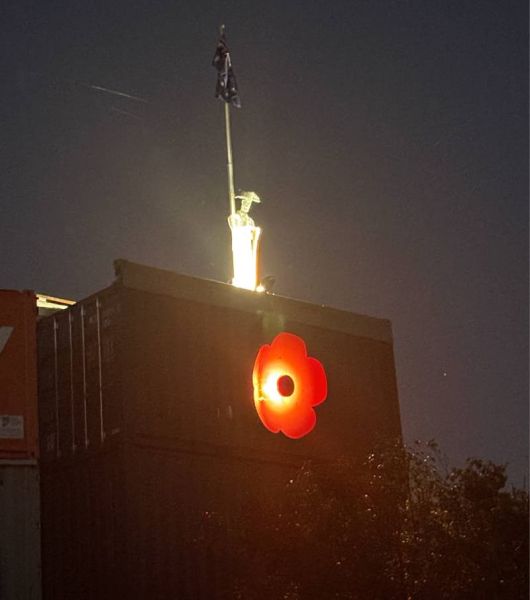
Rural Containers’ ANZAC statement display. photo c/o David Nichols.
Questions That Still Need Answers
The public record still leaves several obvious questions.
Did council object to the container itself, the “Vote 1” wording, the banner below it, or the combined display?
Was the site treated as private land signage, election signage, outdoor advertising, or all three?
Would the removal of the voting instruction from the container satisfy council, leaving only the smaller banner as the political sign?
And is council applying the same scrutiny to other campaign displays during the Farrer by-election?
Those questions matter because a council intervention that sought to reduce a candidate’s visibility may instead have widened it.
This Farrer sign dispute may be over, but the politics around it may last longer.