Australian R&D Tax Reforms Proposed
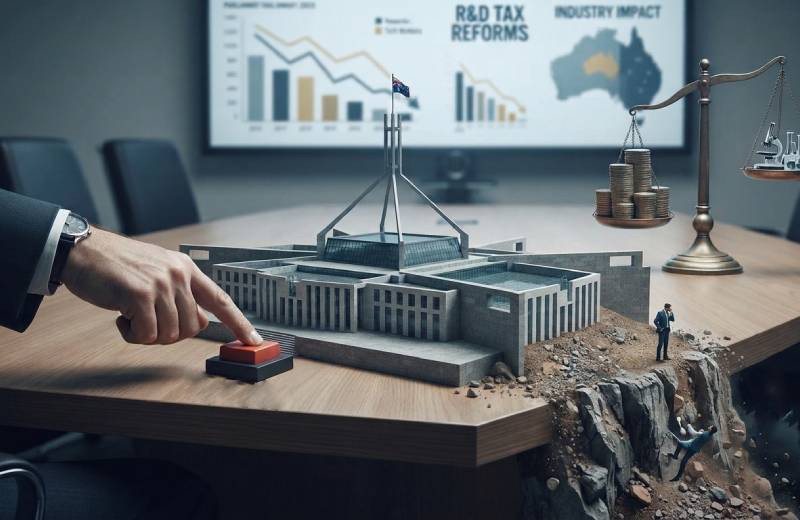
Australian R&D tax reforms could leave established businesses without vital research funding while delivering $650 million in federal budget savings.
The Albanese government introduced the Treasury Laws Amendment (Tax Reform No. 4) Bill 2026 on October 27.
The legislation proposes higher tax incentives for some businesses while restricting cash refunds and excluding certain research-related activities.
The government estimates the changes will save $650 million over five years from 2025–26. It plans to use those savings to help fund broader business tax reforms.
But industry organisations warn that companies conducting long-term experimental research could lose financial support before their projects reach commercial maturity.
Government Targets $650 Million in R&D Savings
The proposed reforms would restructure Australia’s Research and Development Tax Incentive (RDTI), which helps businesses finance experimental research and technological development.
Treasurer Jim Chalmers says the changes will encourage additional investment, support innovative businesses and improve the sustainability of the tax system.
The government proposes to increase the turnover threshold for refundable R&D offsets from $20 million to $50 million.
It would also increase the maximum eligible expenditure threshold from $150 million to $200 million and offer higher offset rates for qualifying core research.
However, the legislation would generally restrict refundable R&D offsets to businesses within their first ten years.
Eligible therapeutic-goods research could receive an extended 15-year period.
The minimum annual expenditure threshold would increase from $20,000 to $50,000, subject to exceptions.
Existing provisions allowing businesses to claim supporting R&D activities would also be removed. The government plans further consultation on recognising certain activities integral to core research.
The reforms are proposed to commence from July 1, 2028.
Higher Tax Incentives Could Mean Smaller Refunds
The government’s $650 million saving represents an estimated reduction in the overall budget cost of the incentive compared with existing arrangements.
It does not mean businesses will receive an additional $650 million for research.
Some companies could benefit from higher offset rates and expanded eligibility thresholds.
Others could receive less assistance because their expenditure no longer qualifies or they lose access to refundable offsets.
For companies operating at a loss, the distinction between refundable and non-refundable incentives is particularly important.
A refundable offset can provide cash that helps finance continuing research.
A non-refundable offset generally reduces tax payable. For a company without taxable profits, it may provide little immediate cash-flow assistance.
That difference could create a funding cliff for established businesses that rely on annual R&D refunds to support experimental development.
The government forecasts that its reforms will encourage an additional $400 million in annual research investment by younger companies.
That figure represents projected private-sector investment, not additional government funding.
Business Groups Challenge Ten-Year Restriction
The Australian Industry Group opposes the proposed ten-year limit, arguing that company age does not reliably indicate research maturity.
Its submission to Treasury warns that the restriction could disadvantage businesses developing technologies with lengthy research and commercialisation cycles.
The organisation also opposes removing supporting R&D activities, which it considers integral to research projects.
The Business Council of Australia supports higher incentive rates and expanded financial thresholds.
However, it also opposes the company-age restriction and removal of supporting activities.
The council argues that research incentives should reflect genuine innovation rather than how long a company has operated.
Accounting and advisory firm BDO separately warned that the proposed age rules could create funding cliffs, uncertainty and additional complexity.
Australian Stem Cell Company Faces Funding Uncertainty
Melbourne-based Magellan Stem Cells illustrates the concerns surrounding long-term research.
The company is developing an experimental stem cell treatment for osteoarthritis.
Its chief executive and chief medical officer, Associate Professor Julien Freitag, says Magellan is 17 years old and preparing for a pivotal Phase 3 clinical trial.
Approximately 1,000 Australians have already participated in its clinical trials, according to Freitag.
The company also invested in advanced manufacturing facilities in Melbourne.
Under the proposed 15-year refundability restriction, its age could prevent it from receiving cash R&D offsets once the new provisions commence, depending on the final eligibility and transitional rules.
Freitag says the company reached its period of greatest capital investment.
He questioned why an Australian research business should lose refundable R&D support at such a critical stage of development.
AusBiotech chief executive Rebekah Cassidy warned on October 28 that the proposed limit could affect clinical trials already underway.
The industry organisation says complex therapies can take considerably longer than 15 years to develop.
It argues that losing refundable support during advanced clinical trials could encourage companies to move research and manufacturing overseas.
AusBiotech wants Parliament to amend the proposed restrictions.
Research Funding Changes Face Parliamentary Scrutiny
The government introduced the legislation amid objections from business, biotechnology and research organisations.
Independent MPs Monique Ryan and Kate Chaney joined AusBiotech and Magellan Stem Cells representatives in calling for scrutiny of the proposed changes.
The government sought an accelerated parliamentary timetable for its broader tax reform package.
The R&D provisions remain proposed legislation, with their final form dependent on the parliamentary process.
The government also committed to further consultation in early 2027 on the treatment of activities integral to core R&D.
Australia’s research spending provides important context for the debate.
The Australian Bureau of Statistics reported that national R&D expenditure represented approximately 1.69% of GDP in 2023–24, below the 2.25% recorded in 2008–09.
Although nominal research spending increased, Australia devotes a smaller share of economic activity to research than it did during that earlier period.
The government’s reforms aim to increase investment by younger businesses while reducing the incentive’s overall budget cost.
For established companies undertaking long-term experimental research, the central issue is whether higher tax incentives can compensate for the loss of immediate financial support.
That question will remain central to the Australian R&D tax reforms as Parliament considers the proposed restrictions.